April 28, 2026
Staying the Course
How Stark State College Built a Support System that Drives Retention & Student Success

Jill Frankfort
About

5 min read
50% → 60% - Full-Time Retention
39% → 45% - Part-Time Retention
23% → 31% - Graduation Rate
INTRODUCTION
A College that Refuses to Let Support Sit on the Shelf
Stark State College is a public two-year institution, serving more than 13,000 students annually in northeastern Ohio. Their student population is predominantly part-time: working adults, many of them first-generation college students, many balancing jobs and caregiving responsibilities alongside their coursework.
These are students for whom a sudden car repair, a missed financial aid notification, or one discouraging grade can tip the balance between continuing their education or not. Stark State knows this intimately, and it shapes how they approach their student communications.
Since 2024, the college has built a layered, interconnected support ecosystem anchored by behavioral science-driven outreach, integrated early alert systems, faculty-to-student connection, and a willingness to look honestly at where their own institutional processes were letting students slip through the cracks. The results speak for themselves:
- More students are staying, with a 10% pp increase.
- More students are completing, with an 8% pp increase.
- Milestones for a federal Title III grant, designed to strengthen institutional capacity for underserved students, were met a full year ahead of schedule.
This is the story of how that happened, and what other institutions can take from it.
THE CHALLENGE
The Support Existed. Students Weren't Finding It.
Ask any college leader what stands between their students and success, and you'll get a consistent answer: it's rarely a shortage of resources. The harder problem is the distance between a resource being available and a student using it to its fullest.
Stark State was no different. Dr. Lada Gibson-Shreve, who has served as Provost and Chief Academic Officer for 13 years, describes the challenge: students don't think about the support available to them until they're already in trouble. By the time a student is struggling with academic self-doubt, financial pressure, or the slow creeping feeling that they don't belong, they've usually stopped paying attention to institutional messaging.
“We've always had the support services needed by our students. We inform students, but students are like everyone else. You don't always think about support services until you're in need.” — Dr. Lada Gibson-Shreve, Provost and CAO, Stark State College
The institution also faced a structural challenge common to colleges serving predominantly part-time populations. Part-time students are less tethered to campus by design. Many attend class and leave; some take fully online courses and never set foot on campus at all. They're harder to reach through traditional channels, harder to catch through standard early alert systems, and more exposed to the kind of real-life disruptions that derail progress. For Stark State, part-time students represent the majority of the student body.
Then there was a quieter challenge lurking in the data. Students were completing every credit required for certificate programs, but never submitting the formal graduation applications. Not because they failed. Not because they gave up. Simply because their focal point was the license or industry credential at the end, not the Stark State certificate. They were succeeding without being counted. The institution was investing in outcomes it couldn't see, measure, or report on.
STARK STATE GOALS
More Than a Grant: Building Something That Lasts
Stark State's Title III federal grant gave the college a structured framework and a set of concrete benchmarks: improve student retention, improve graduation rates, and close gaps for underserved students. Those targets were the floor, not the ceiling.
What Dr. Gibson-Shreve and her team set out to build was an infrastructure that didn't depend on students knowing to ask for help. They wanted earlier intervention. They wanted more integrated referral pathways so that any faculty member who saw a struggling student could get them connected immediately, without the student having to navigate the process themselves. They wanted outreach that connected students to support in the moment.
Most of all, they wanted it to be sustainable, not a one-term initiative that fades when a grant cycle ends, but a set of systems and habits that would outlast any single funding source.
THE APPROACH
A Framework Built for the Real Lives of Students
Stark State built a framework where multiple strategies work together. Each element was chosen to address a specific gap, and together, they shaped something more than the sum of their parts.
Behavioral Science-Driven Outreach with P+
The most consistent thread running through Stark State's retention work is a deceptively simple idea: information only helps if it resonates with students and reaches them at the moment they need it. Traditional institutional communication misses that window. Orientation materials land before students know what challenges they're about to face. Mass emails disappear into inboxes. Flyers are background noise.
Stark’s approach centers on personalized, behavioral science-based outreach delivered directly to students on a regular cadence throughout the semester. Developed in partnership with Persistence Plus, the platform has served more than 11,000 Stark State students and has sent nearly a million messages since August 2024.
The outreach is also more than communication; it’s a two-way conversation. Students respond. They share what's going on, surface challenges they wouldn't raise in an advising office, and engage in ways that one-directional messaging never allows. For students taking fully online courses who may never set foot on campus, that exchange can be the thing that makes them feel seen and worth staying for.
How Stark’s Messages Are Built
The content isn't built on intuition. Every message Stark State students receive is grounded in a framework P+ has developed and tested across thousands of messages. Messages are written by behavioral scientists, who have spent nearly a decade working exclusively on effective outreach to students, and tested in more than 10 randomized controlled trials. The targeting operates on three dimensions simultaneously: who the student is, what they're facing, and where the institution is in its academic calendar.
“Our messages aren't just well-timed. They're intentionally designed to shift how students think about asking for help. A lot of students arrive at college believing that needing support means they don't belong there. We work to change that. Every message is built to normalize the experience of struggle, reduce the stigma around reaching out, and make taking that first step feel like the obvious next move,” shared Dr. Ross O’Hara, Chief Learning Officer for Persistence Plus.
Further, messaging is calibrated for specific populations, such as incoming students, returning students, near-completers, adult learners, first-generation students, student parents, online students, and STEM students. A first-generation student navigating their first midterms needs something fundamentally different than a near-completer who's lost momentum in their final semester. The messages include use-tested behavioral levers that drive impact, focusing on academic self-doubt, stress and anxiety, financial insecurity, fear of seeking help, lack of career clarity, time management, belonging, and motivation.
Examples of Behavioral Levers
Goal-setting: Prompts students to meet academic deadlines and follow through on plans they've made.
Personal values: Connects coursework to what a student actually cares about, such as family, career, community, building intrinsic motivation.
Reframing challenges: Helps students interpret difficulty as a normal part of college life, not evidence they don't belong.
Promoting help-seeking: Surfaces campus resources at the moment they're most relevant, not just at orientation.
Growth mindset: Counters imposter syndrome and stereotype threat by keeping focus on progress and possibility.
Social belonging: Reinforces a student's connection to Stark State and their program, especially important for online and part-time students.
As students respond and share more about their goals, challenges, and experiences, the platform learns and messaging adjusts. It's a system that gets more useful over time -- not a fixed script that runs the same playbook regardless of what's actually going on with a student.
“Students appreciate the reminders about the services we're offering, the motivation to keep them engaged, and to keep them headed toward that career goal they've established. Receiving those reminders on a regular basis has been ideal.” — Dr. Lada Gibson-Shreve
A Closer Look at How It Works: Supporting Student Parents
More than half of Stark State students who were surveyed through the platform reported that they are raising children. The P+ platform identifies these students and delivers messages that speak directly to their reality, acknowledging the guilt many student parents feel about time taken away from family, normalizing that experience through research-backed framing, and helping them connect their identity as a parent to their motivation to complete their degree. It's a concrete example of what behavioral science-driven outreach actually looks like in practice: not a supportive text, but a carefully designed conversation grounded in what we know about that student's life.
Students have been clear about what resonates with them.
WHAT STUDENTS THINK OF STARK STATE’S PERSONALIZED OUTREACH
- “I like that even if I didn’t always reply, support was always there. There were moments that were really difficult this semester, but support was always there for me. Thank you all.”
- “The consistency of concern and support is top tier.”
- “It prompted me to reflect on how I was approaching college.”
- “I'm taking web classes so I liked feeling like I was still part of the school, even though I'm never physically on campus.”
- “The motivational check-ins throughout the semester have been great. And reminders about support services, that's what I needed.”
- “It was so nice to have support and to be heard. You truly cared, which is so impactful and makes all the difference.”
- “I like that it isn't the same for everyone. Some of us get different questions than others. It's nice to know it's personalized.”
- “You learn cool new ways to handle stress and studying.”
- “It was great to get the text messages to keep me focused, encourage me, and give me helpful tips along the way. Thank you.”
Extending the Approach to Faculty and Staff
As another key aspect of their strategy, the institution auto-enrolled faculty & staff in the messaging. Since September 2024, more than 480 faculty and staff have received messages, with 80% rating them positively.
The focus is practical, helping faculty access campus resources, supporting their own well-being, and equipping them to connect students to the support they need. Given that adjunct instructors represent a significant share of Stark State's teaching staff and are often less plugged into student support infrastructure, this extension of the behavioral science approach is a meaningful piece of the picture.
Early Alert and Integrated Referrals
Running parallel to more meaningful outreach is Stark State's fully integrated referral system. This puts every campus support service, from tutoring, financial aid counseling, and food assistance to mental health resources within a few clicks. When a faculty member sees warning signs, they make a direct referral. The service handles the follow-up. The loop closes without the student needing to know which door to knock on.
The system also manages advising transitions, carrying full documentation when students move from Gateway student services staff to faculty advisors at 15 credit hours, so no context is lost in the handoff. Faculty members use an early alert system to monitor student academic progress, identify concerns early, and send positive messages that recognize achievements and encourage continued success. Faculty members can also refer students to a dedicated case manager for an individualized improvement plan before formal probation thresholds are ever triggered.
“Our goal is to ensure students know what services are available and feel empowered to engage with them. If they need extra support, we provide direct referrals to ensure they get the help they need.” — Dr. Lada Gibson-Shreve
Fixing the Invisible Graduation Problem
One of the more surprising findings from Stark State's internal audit: students were completing every credit required for certificate programs but never submitting the graduation application. Their goal was the industry license or credential, not the college certificate. They were succeeding without being counted.
“We were missing students not because they didn't earn it, just simply because they didn't get counted. Looking for ways that we can improve efficiency like that has been key."
The college went back through five years of records, contacted every student who hadn't applied, and reintroduced paper application forms for faculty to distribute in high-completion courses. A software solution is also in progress that would automatically enroll students in stacked certificate programs when they declare a related degree, removing the manual step entirely.
THE RESULTS
What a Multi-Year Investment Looks Like in the Data
The results from 2024 to 2025, measured fall-to-fall, tell a clear story about what happens when a college builds its support infrastructure with intention and keeps building it over time:
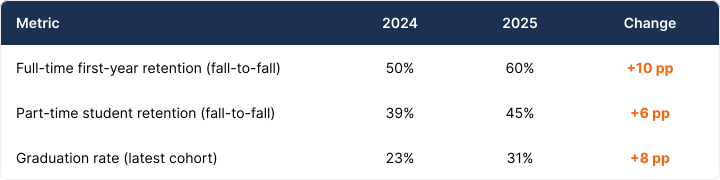
The part-time retention figure deserves particular attention. Because the majority of Stark State students attend part-time, a 5-percentage-point improvement in that population represents a more significant institutional lift than the number might suggest. Part-time students have fewer structural ties to campus, more competing demands on their time, and historically lower persistence rates than their full-time peers. Moving that number is hard, and Stark State moved it.
On graduation rates, the shift from 23% to 31% reflects more than a single year of intervention. It reflects the cumulative weight of years of incremental strategy, including, in part, the certificate application fix that began capturing students who had already earned their credentials but weren't being counted.
Title III Outcome:
Stark State hit their federal retention targets a full year ahead of schedule and met the graduation goal for the grant before the project period closed. Both outcomes reflect years of compounding investment, not a single-semester fix.
Title III grant benchmarks complete the picture: Stark State arrived at their federal retention targets a full year ahead of schedule and had already met the graduation goal before the grant period closed.
On the Part-Time Numbers:
A 6-percentage-point retention gain among part-time students, at a college where part-time enrollment is the majority, represents hundreds of real students who continued their education this year when they might not have. These are students for whom college is frequently a financial stretch, a logistical challenge, and an ongoing act of determination. Every point represents someone who stayed.
THE BIGGER PICTURE
The Long Game: A Philosophy that Shows Up in Everything
Dr. Gibson-Shreve doesn't talk about these results as a breakthrough. She talks about them as the product of years of sustained, incremental effort, and that framing is, in some ways, more valuable than any specific tactic.
“Like everyone else, we want to implement a strategy and immediately see results from it, but it doesn't work that way. Success has come through slow, incremental growth. You have to stay persistent and keep at it. If you aren't seeing the results you want, you have to continue your focus, give it more time, and/or adapt your approach.”
That philosophy is visible in every decision Stark State has made. When supplemental instruction funding was reduced, they didn't abandon the high-DFW course strategy. Instead, they found ways to sustain it through classroom assignments and tutoring referrals. When they found the certificate application gap, they didn't log it as an anomaly, but rather went back and contacted students who had been missed. When they discovered their drop policy was working against their own students, they changed it.
Stark State has built a culture of continuous improvement, held together by leadership with the patience to let strategies mature and the honesty to examine what isn't working.
The core insight threading through all of it is the same one Dr. Gibson-Shreve keeps returning to: you can't help students with resources they don't know about. "We've always had the services," she says. "We have to find ways to get it to them at the moment that it's needed." Behavioral science-driven outreach and integrated referral are, at their core, two different answers to that same challenge.
About Persistence Plus
Persistence Plus is an AI-enabled student outreach platform that uses behavioral science-based messaging to help colleges improve retention, persistence, and graduation rates. Built by PhD scientists and validated through more than 10 randomized controlled trials, P+ delivers personalized, research-backed outreach that addresses students' specific challenges, normalizes help-seeking, and keeps students connected to the resources that matter. 100% of P+ partner institutions achieve positive ROI in the first year.
Subscribe to our newsletter
Stay updated on our latest posts and research-backed insights.
Thank you! Your submission has been received!
Oops! Something went wrong while submitting the form.


























Jill Frankfort
CEO and Co-Founder
Ms. Frankfort is the Co-founder and CEO of Persistence Plus, a mission-driven company that works with colleges, non-profits, and employers to propel more students to credentials. The Persistence Plus model leverages behavioral science and an intelligent software system to uniquely engage and support students. Since introducing “nudging” to higher education, Ms. Frankfort and her team at Persistence Plus have helped students across the globe toward their goal of earning a college degree. More than ten gold-standard RCTs show that Persistence Plus students persist at greater rates than students without the service. Her work has been recognized by the Online Learning Consortium, Kauffman Foundation, Milken Family Foundation, and Blue Ridge Foundation, among others, for its innovation and impact. Ms. Frankfort is a graduate of Brown University and received her master’s in education from Wake Forest University.
%201.svg)